CW: death, pregnancy
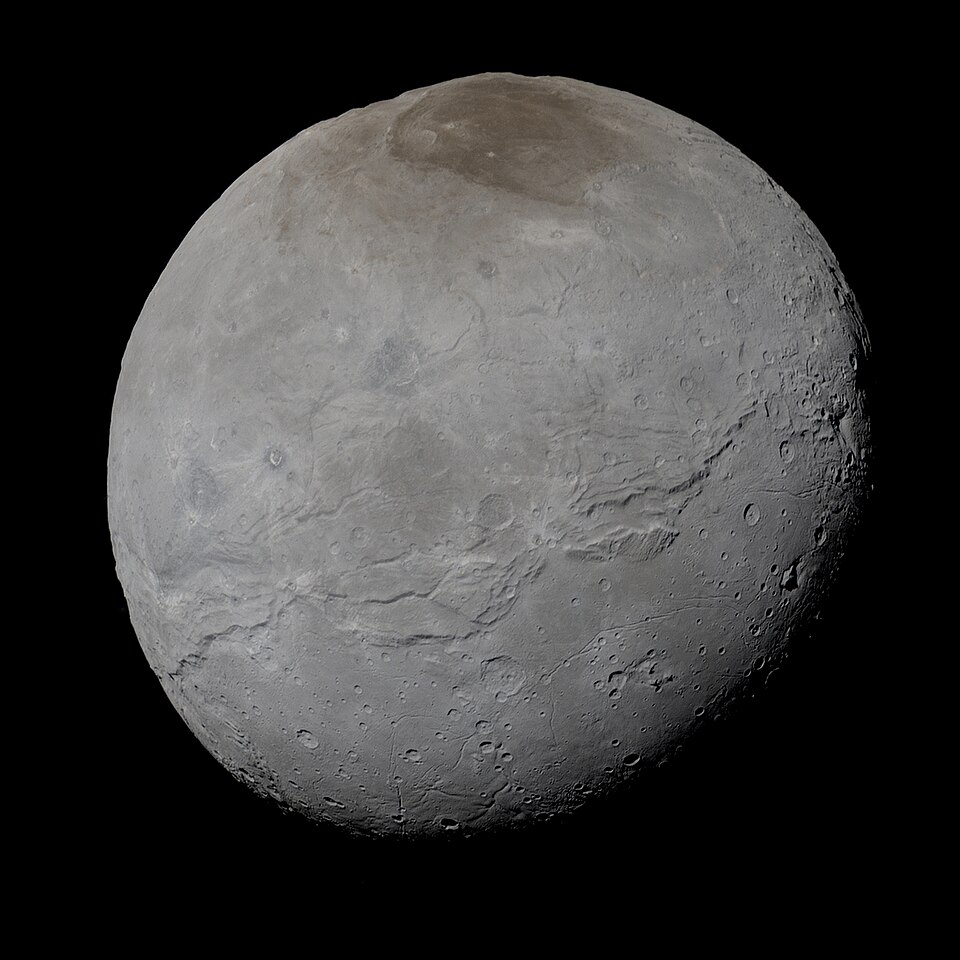
At the edge of the border which humanity once drew around their sun, a pair of bodies less than planets has danced for billions of years. Tidally locked, they gaze upon the other’s lonely face, longing for the day they will make contact again. In 2274, humans made their final exploratory outpost on one of these bodies; Charon, the largest moon of Pluto, was made home to the furthest point of human domination in the known universe (relative to their origin point on Earth).
Affixed to the icy wall of the crater ‘Dorothy’ was a habitat encased in a transparent dome. Generational staff had once performed a small variety of tasks to support the ongoing function of the mission center, including scientific research, structural maintenance, and ecological equilibrium. Research had originally been oriented around long-term habitation in deep space and collecting data samples from a point in the system that was less guarded by the sun’s shielding presence. In the years that had passed since its establishment, however, the site of the Charon Deep Space Observation project had fallen to a state that suggested it may not be long before the moon’s ice swallowed the structure and reclaimed its natural state.
The first generation of staff arrived the same year that the facility had been completed – twelve human-born adults that had been cryogenically preserved on their journey, scheduled to arrive at a newly furnished home and assume their designations after a lifetime of rigorous and meticulous training. There was no room for variance or error on Charon; the delicate ecosystem required to sustain the station was under constant risk of collapse.
The original lines on Charon had been divided into four teams of three, each team containing a researcher, an engineer, and a biologist. The staff was expected to fulfill their functions for the duration of their lives, as well as begin the gestation process for the next line of staff using mechanized parthenogenesis. The process was physically intensive on the body, and needed to be timed carefully to ensure that each member of a generation would be born in a relatively small window, but with enough consideration that there would not be a labor shortage due to simultaneous late-term pregnancies.
Within two generations, the population sustained a loss. A researcher’s pregnancy had complications due to a data error with the parthenogenesis machine, resulting in a premature extinction of her line. While anguish was shared across the staff, they did not fail to reorganize themselves appropriately to focus on their missions. It did not diminish their love for each other to return to their responsibilities – work was the only definition they had for life, so each shift became a memorial service.
The final communication received from Earth came during the fourth generation. The annual ritual of sending data packets and geological samples continued until it became a generational practice, done to mark the arrival of a new worker into the collective.
By the fifth generation, the workforce had been cut in half. Only 6 lines remained, resulting in the consolidation of duties and a restructuring of the education program. Systems deemed non-essential became low priorities for repairs and resources, and eventually were abandoned once their absence became comfortable. One of the remaining 6 was found to be reproductively non-viable, which meant the line would end with them. Not having to endure parthenogenesis had a positive impact on their lifespan, as they lived an additional two decades beyond the typical 35-year lifespan. This caused a shift in the group’s culture, and she became the center point on which the system turned, serving as instructor, worker, caretaker, and historian. Her perspective made her a spectacle in the icy wasteland of Charon: she became She Who Endures.
From her came the culture of naming. Previous iterations of women were all called by their founding progenitor’s last name, plus a number to indicate their generation. She Who Endures reminded them that far beyond the speckled blackness was a blue and green heaven which their ancestors called home. She spent years learning the words for tastes and smells the staff would never know; digging through archival records long abandoned to find catalogues of home and all its beauty. Redwood forests, endless deserts, a living tundra, windswept plains… A vast and beautiful landscape that filled the staff with the longing of discovery. The staff found themselves made more human in the act of learning, and elected to celebrate the divinity of their origins with a naming ritual. Each member of the group took turns selecting a plant whose seeds they carried in their vaults, adopting its name, and cultivating it.
The knowledge that Earth was a real place turned their love fanatical. Some lines started spending their days in the biological center, which had become a greenhouse. It had always served a function as a garden to grow resources that staff needed for nutritional, medicinal, and experimental purposes. By Generation 6, it was overflowing with flora. The remains of progenitors and failed generations alike were heat-treated and folded into the soil along with the plants bearing their chosen name. While the station around them continued to fall into disrepair, the progenitors routinely made time to visit the garden beyond maintenance purposes. One of the remaining lines could be found there frequently, and over time, the intervals between their absences from the group grew shorter. They spent the remainder of their days in the garden, sitting on the floor with their knees tucked against their chest, staring vacantly at the plot where one of their progenitors, Alder, had grown into a sapling. Nutrients were repeatedly brought to them, and more often than not would be discarded after becoming inedible. Eventually, the group realized it was no longer an effort that they could sustain, and they moved their attention back to the work.
As time went on, the number of lines decreased with each generation. 180 years from the original humans, there remained only two: Yarrow and Sweetgrass. They lived in love in the remains of what had once been a massive facility. The only enduring spaces in the habitat were the most external rooms, bordered by the glass dome allowing them a view of the vast icy crater in which they lived. Their time was split between the garden and the mission control center, where they had consolidated their existence. Still accessible to them was the medical bay, where there was an abundance of supplies for a thriving colony that never came to be, stored next to the parthenogenesis machine, untouched by time.
They spent their youth imagining a different life, but with time, maturity hardened their expectations. Yarrow had always been more cynical, but Sweetgrass struggled to adapt to the realization that their lives had been drained of meaning. Many other viable lines had simply opted not to use the parthenogenesis machine out of despair after Earth stopped sending messages. Early in their lives, they had both imagined refusing the machine themselves and following the fates of all the lines before them. The story of their demise became the foundation for their love, and in time, Sweetgrass changed her mind.
“What if it’s different, this time?” She followed Yarrow through the doorway between the garden and mission control, gently brushing a String of Pearls that had entangled itself in her lover’s hair. Yarrow flinched, but not from Sweetgrass’ touch.
“What could be different?” Yarrow hated the expression she wore, but couldn’t hide the pain this conversation brought up within her. “How could we bring daughters onto this dying rock? We live in a prison.” She immediately regretted the implication of Sweetgrass being her cellmate, but the only thing she could change about it was her tone. “And, while I intend to spend every day of this sentence with the most beautiful woman in the galaxy,” She reached up a hand to cup the other woman’s cheek and offered a softer expression. “I don’t want us to shorten that time together just to create daughters who will have the same predictable fate.”
Sweetgrass pressed her face into her partner’s hand, closing her eyes to keep in her growing distress. “What if… What if Earth remembers us? What if we find a way out of here?” Her eyes opened, hazel visible through the welling tears as she stared up into Yarrow’s saddening expression. “What if I just love you, and I don’t want us to end yet?” The words knocked the wind out of Yarrow, who stood there, lips slightly parted as she tried to make an argument against the only person who’d ever really known her.
“Sweetie…”
“What if we didn’t use the machine the way everyone else did?”
The suggestion stunned Yarrow. Her face twisted with confusion, and she repeated back, “Use… the machine?”
“What if… I carried your progeny?” Sweet stared up into her lover’s eyes, watching the dark brown recede against a swelling black orb.
Yarrow’s face flushed, and her hand dropped from Sweet’s cheek. The idea was completely foreign in concept. The parthenogenesis machine had only ever been explained to them in terms of its ability to generate and implant embryos from a host DNA source. After a moment to process the thought, Yarrow shook her head. “No. Absolutely not.” She pulled away from Sweetgrass, moving towards one of the command chairs on the other side of the room. “I don’t know where you get these ideas, but I think you need to eat something, because this is wild, even by your standards–“
“Yarrow, please, just listen to me–“
“–we don’t even know how that thing works, to start, so I’m not sure how you think you’re going to put my DNA in your body and just ‘make a baby’…” Yarrow threw their hands into the air and waved them mockingly. “But even if you did, we have no way of knowing that the fetus will be viable, AND you’re putting yourself at risk, just to make another worker to replace us, all for what?!”
“FOR US!” Sweetgrass screamed, her face red. Yarrow was immediately stunned into silence – they had never experienced this kind of social display from their love, and immediately, they felt the jagged anxiety within them start to soften. Whatever fears Yarrow had, they knew in that moment Sweetgrass carried them too, and others she had yet to understand. She closed her mouth, lowered herself into the seat, and listened to her partner as she unburdened herself.
“If our lives don’t mean anything anymore, then why bother trying to keep them for so long? Why not try to put forward something that might survive us? Even if it kills me, death can’t be worse than this life.” Sweet’s voice trembled to speak between gasps. The words poured out of her in droplets, but failed to match the rhythm of the rainfall hitting the habitat floor. “I love you – you are my world. And if we could live out here amongst the stars forever, I would! But I can’t sit here for decades and just rot!” The dam broke, and Sweetgrass poured herself onto the floor in heaping sobs. She felt Yarrow hit the ground next to her and was pulled into her embrace, twisting to plant her face in her partner’s shoulder. Yarrow’s shirt caught the rest of the flood, and she made soft, soothing noises as she rubbed small circles around Sweet’s thoracic vertebrae and placed tender kisses on her head.
As the storm passed, Yarrow took in a breath of her lover’s dark hair, cradling her moon against her body as she thought of what to say next. Sweetgrass was silent except for the soft sounds of respiration. Eventually, Yarrow settled on, “I understand. And I love you. And…” Her chest swelled with a sigh, followed by a long and loud exhale and a tight squeeze. “And if we can figure out a way…”
Before Yarrow could finish her sentence, Sweet jolted up, sitting back on her own weight with such force that her face brushed against Yarrow’s. “Are you saying…”
Yarrow conceded her intent with a smile. “I will support you in trying to make it work.”
The first look on Sweet’s face was genuine love, with a glimmer of appreciation and disbelief. After a moment, her face split into an enticing – and familiar – grin, and she leaned in towards Yarrow again. “I’m gonna need a little more than your support…” She said in a husky tone, eliciting a chuckle from her love.
“Come here, you anomaly,” Yarrow pulled her lover into her, the contrast of their tones forming a landscape as their faces gently pressed into each other. No matter what would come, they would see it together.


Leave a Reply