I wrote this piece for my Substack on Jun 15th, 2026, a few weeks before I entered a 12-week intensive outpatient program. I have spent the better half of my life being afraid of vulnerability, because I know what it costs, and have rarely felt a reward from it. The last few months have felt like a markedly different experience from what I have known.
I think it would be unkind to refer to me as a ‘sociopath’, but I do think that I’ve come to the realization that the way I experience emotion is so tied to my need for self preservation that I am often at odds with the world around me in a chaotic, sometimes violent way. It is no wonder anymore why I have such a long history of personal relationship failures, from this new perspective – despite the framework of compulsion holding me to be as good as possible (in a way that resembles more of a high score than an internal feeling) I continuously found that people around me seemed unsafe. The words “I just don’t know how to talk to you” echo through so many moments of my life, and I never understood why. I always fancied myself perfectly reasonable, yet misunderstood by others, and therefore helpless to circumstances beyond my control. It is a spiderweb – a nest I build that warns me of danger and works to passively ensnare my next meal. It is a system that can withstand damage and be replicated, because I work it from my own body from the metabolism of each feast.
It is a fragile delusion that I have come to understand creates more of a vulnerability than it provides safety.
I have decided the trees are not for me.
Content warning: this piece discusses graphic details of suicide attempts, child abuse, drug abuse, and overdose. There is a lot more to this story than I have written, and hope to give it new life some time soon, as this month marks the 15 year anniversary of my brief stint of involuntary institutionalization. There is something about the evenness of that number that feels like I owe it celebration. Maybe it has to do with my 34th birthday coming up this month – two events that have been irrevocably intertwined for almost as long as I’ve had birthdays to celebrate.
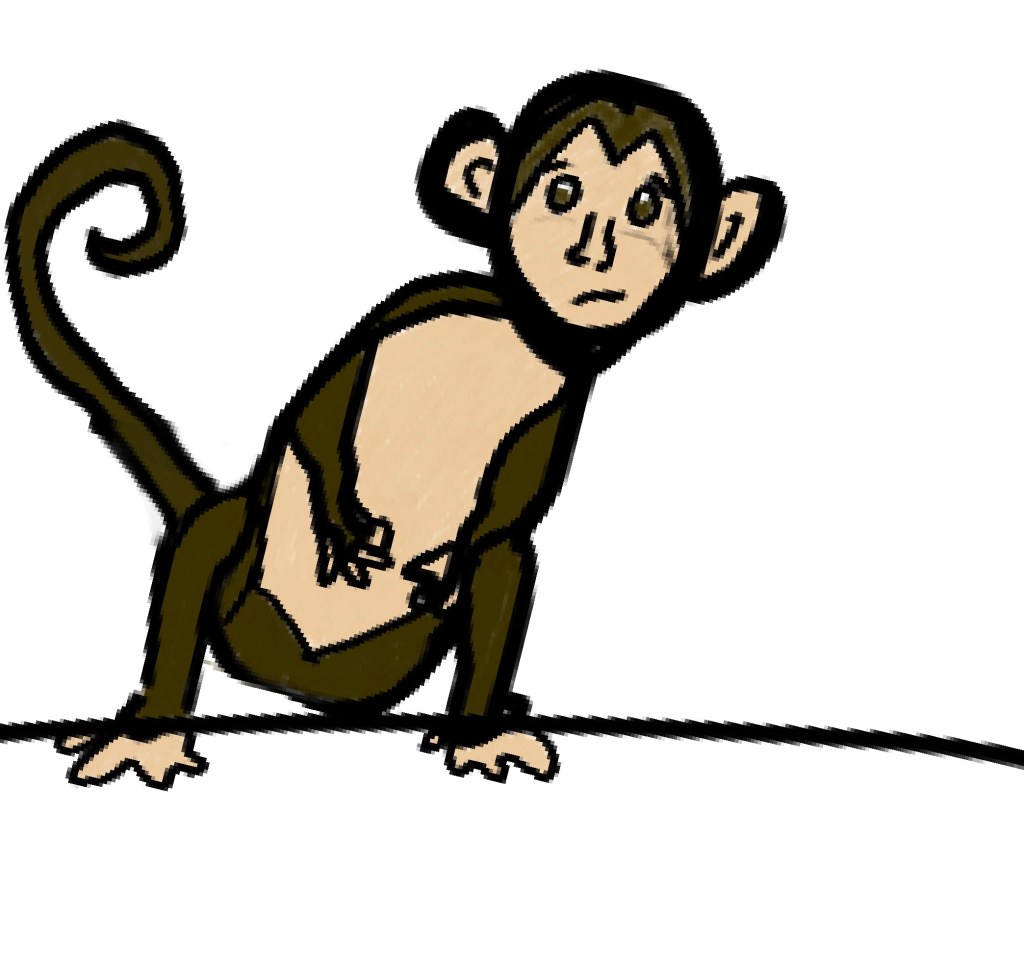
Please take consideration and care of yourself for this read, with the knowledge that I am in a much brighter, freer place today than I have been, maybe in my entire life. If you start to feel bad, please take a look at this apprehensive monkey from the art piece related to this that I am working on.
The first time I attempted suicide was my 13th birthday.
I remember sitting on the floor of the bathroom of a home in southern Florida, with Hurricane Wilma looming overhead, ready to make landfall in the next few hours. My paternal grandmother (in her infinite wisdom) had decided that today was the day I needed to make good on a “promise” I made her to clean the bathroom of the home so that she could flip it.
The promise was that, at 12 years old, I asked my grandmother for McDonald’s, and she agreed to buy it for me if I “helped her out later”. I didn’t know, at the time, that this would manifest as her showing up to my family’s home while the county was on notice for a hurricane, having a shouting match with my mom, and forcing me into a car to lock me in a bathroom until it was “spotless”.
I felt the cold linoleum beneath me, thoughts rolling through my head about how little I must matter to anyone, if this is what my life would always be like. Pushed and shoved between place to place, people screaming in my face, spit flying from their mouth to my skin as the closest form of human connection I would ever know.
And so I tried to eat the Clorox wipes.
More accurately, I clutched a wad of wipes between both hands and bit down into it like a forbidden fruit, choking down the bitter lemon-flavored, bleach-and-chlorine-free nectar that, in my underdeveloped adolescent mind, would let me die. It was an act meant to grant me freedom into nothingness, and leave behind this painful world I had come to resent. Leave behind the long lonely silence of my home, occasionally broken up by violent shouting. Leave behind the people who “knew best” what I needed without ever knowing me. Leave behind whatever fucked up legacy I was being molded to inherit.
Notably, it did not kill me. Instead, it fed something inside of me that I could not understand the repercussions of until much later.
The next time I felt the urge to die, I reached out for help. I walked into a hospital, explained I was fantasizing about driving my car into the river, and walked out with an antidepressant. I had not really, fully made sense of my life by 18 years old, but I knew that I was unhappy with where it was taking me. I felt like a passenger in a roller coaster whose design was torturous and unpredictable, struggling to catch my breath in the slower parts of the track, knowing that I would soon be thrown back into disorientation, and while it was becoming familiar, I could see that the ride would not stop itself, and I begged for any way to get off the ride.
That’s when a family member introduced me to Tramadol.
She had been taking it to treat chronic pain from a major car accident, and when I couldn’t stop having repeated panic attacks, I think she became distressed from my distress, and she gave me a small, white pill out of a large bottle in her purse, told me to lay down on the couch, and for one of the few times that feels memorable to me, she coddled me. She stroked my hair and told me I would be okay while I drifted into a new type of disorientation – bliss. It became part of my daily routine. I would come home, get my dose of Tramadol, and become vegetative as an alternative to the miserable sounds I would start to make when I couldn’t fight back the thoughts about I was going through.
The main triggering event had been a breakup. About a month before my second attempt, I broke off an engagement to my high school boyfriend (gagging a little as I write this) after I found out that he had been cheating on me. The dynamic of most high school couples is toxic, by default, as most children at that stage are still fantasizing about the life they have, with no real roots to understand the life they will be allowed. And thus, when the fantasy of marriage fell apart around me, I became destabilized, and looked for any alternative to the immediate, inconsolable sense of doom I felt.
And then, one day (October 11th, 2011), I decided enough was enough, and I was calling it quits. After reassuring several close friends (including my ex) that I was coping well and getting over it, I hatched my plan. I did a web search for “How much Tramadol does it take to kill 120 lb adult?” and learned the approximate amount. I lurked in the living room on the Xbox until my family member got home, counted out exactly enough
pills while she was in the bathroom, and slipped them in my pocket. I waited until late at night, made a subtle-yet-cryptic Facebook post, and downed my small hoard with eagerness, hoping that when I closed my eyes this time, they would never again open.
I imagine, dear reader, that by this time in the essay, you will have come to the conclusion that I am rather terrible at suicide.
A dear insomniac friend had seen my post and reached out on messenger to check in, and my replies were unsettling and disoriented, so in a panic, they told their father, who called the police. I will save the rest of that experience for another time, as there is much to say and hardly enough bandwidth to process it.
After two weeks of involuntary hospitalization, I was released back to my family home. I tried to keep treading water – I went to community college, got involved in student government, tried casual sex and relationships, and for the first time, I started to feel like I had my feet under me. My life wasn’t ideal, but there were moments that felt enjoyable. There were people who I could relate to, and who could relate to me, and who were tolerant of my eccentricities and forgetfulness. And as I began to recover, I failed to see how much the people around me had not.
My closest friend, who has been my best friend since we were in elementary school, developed severe anxiety, and I struggled to understand why she felt like the world around her was ending, when I always saw her as so bright and optimistic. My uncle, who was leaning into being a musician at the time, wrote a song – of course, about my mother’s grief in the experience. And my family member, who had never been particularly warm or comforting, withdrew in a way I had misread as “giving me space”. I thought that, perhaps, new boundaries I had established were being respected, and I could live with this new, less invasive person.
One day, while we were out at dinner with extended family, she took an opportunity to make a joke in front of everyone about how good I am at swallowing pills. I can’t remember how most people reacted – I just remember looking into her eyes across the table as she drank from the straw in her margarita. Her eyes looked pitch black, eyebrows positioned at an angle that said, ‘Go ahead. Hit back. See what happens.’
That night at home, I approached her as she sat at the dining room table. I attempted to employ a strategy I had learned from one of my therapy sessions in hospital and communicate to her how I was feeling. “When you said that in front of everyone, it brought back the feelings that made me want to kill myself in the first place.”
Her face, which had never been soft, twisted further into disdain. She said something to me that clarified so much, and without another word, I walked into my bedroom, shoved what I could into a bag, and left. I was fortunate enough to have my own car, which became one of my living spaces for the next few days before I moved in with a friend.
Life in the free-fall lasted for years. Occasionally I would strike something on the way down – a relationship, an attempt at college, job after job after job – but even two decades after my first attempt, I do not feel that I have my feet on solid ground. The best I can be described as now is arboreal – carving out an existence in the trees, competing with the chaotic network of architecture that grows around me to avoid a fatal fall. I feel fear in every movement, because I know that if I place my hand wrong, if I trust the wrong branch to hold my weight, that could spell the end. And in this framework, I have developed a coping mechanism to feel some sense of power. I gaze downward.
When I focus on the idea of my death, on the idea that I could choose it at any time, it feels stronger than the grip I have on life. It feels like the only option that is certainly mine. My entire world feels like an apparatus built around me that I did not ask to fight, and yet I have no choice, until I consider the option of letting go. It is the tiny release valve on the pressure cooker of my mind. It feels like an exchange of neurotransmitters – stress agrees to swap out with relief and my mind feels clearer to assess my options. Do I try to keep going forward, or do I call it here?
I have found myself asking this question so frequently throughout my life that I do not have a good gauge on if I’ve ever really ‘recovered’ from my first suicide attempt. I know that I have put in my fair share of effort – a decade of various methods of therapy, a dozen medications and providers – but through all of that, there are still moments where my gaze drifts downwards, and I am reminded that, just in case all else fails, there is a simpler, perhaps more natural trajectory…
All that to say, I do not want to die.
Despite everything, I want to be alive in this world. I find incredible joy in so many moments, in so many things, that even the parts of existence that bring me pain can serve as a bitter contrast for the sweetness. I wouldn’t choose death willingly, knowing what and who I would be leaving behind. I could not close the door on the infinite universe of possibility that lies before me. Even in the darker moments, it feels like the choice between running towards the train wreck to help, or running away home to pretend I was powerless.
So, my life persists. It is not joyless, but weighed down by baggage I did not ask to carry, but feel so attached to that I cannot bear to leave behind. Perhaps it is more complicated than that, but I know that there is some level of sentiment to my pain that is hard to part with. Maybe that will bring the weightlessness I have longed for while swinging between branches.


Leave a comment